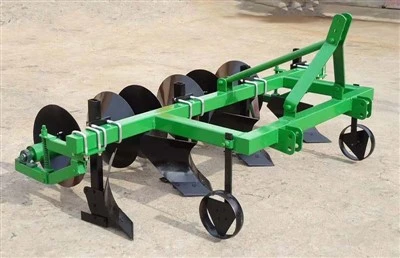


3S series deep plough is suitable for deep plowing operations of crops such as potatoes, potatoes and cotton. It can break through hard soil, level soil, maintain underground moisture content, and remove residues. Adjustable depth, wide application range, easy to operate.
3S - Deep plow is an agricultural machine mainly used for deep tillage in farmland. It has the functions of breaking up surface soil compaction, loosening the soil, retaining groundwater and eliminating stubble. It is suitable for planting crops such as potatoes, beans, and cotton.
| Deep tiller Model | 3S-1.0 | 3S-1.4 | 3S-1.8 | 35-2.1 | 3S-2.6 |
| Working Width (mm) | 1000 | 1400 | 1800 | 2100 | 2600 |
| Working Depth (mm) | 100-350 | ||||
| Tine Qty | 5 | 7 | 9 | 11 | 13 |
| Total Weight (kg) | 210 | 240 | 280 | 320 | 370 |
| Tractor Power (hp) | 25 | 40 | 50 | 80 | 100 |
| Linkage | CATⅠ3-point Mounted | CATⅡ 3-point Mounted | |||
Deep Subsoiler for Tractors with High-Strength Steel Components for Maximum Soil Loosening Efficiency
The deep loosening machine can adapt to different soil types and soil covered with a large amount of straw.
It has the functions of breaking the plow bottom, restoring the soil surface structure, improving the soil's water retention capacity, removing some weeds, reducing pests and diseases, leveling the surface, and improving the level of agricultural mechanization.
*The subsoiler is constructed entirely of welded square tubes, making it durable and easy to maintain.
*Different models feature varying numbers of plow legs, constructed from high-quality 65Mn steel, providing powerful soil-breaking capabilities.


Tractor Three-Point Mounted Subsoiler for Efficient Deep Soil Loosening and Land Tilling
3S - Common deep plow models include 3S-1.0, 3S-1.4, 3S-1.8, 3S-2.1,and 3S-2.6. Different models have different plowing widths to meet different farmland operation needs.
The plowing depth of a deep plow can be adjusted by changing the relative height of the plow frame and the ground, such as adjusting the height of the support wheel. When the support wheel is raised, the plow body penetrates deeper into the soil, and vice versa.
The plowing depth of the deep plow is adjustable (for example, most models can be adjusted within 10-30 cm), and can adapt to different types of soil (such as clay, loam, sandy loam, etc.) and the tillage requirements of different crops (such as potatoes, beans, fruit trees, etc.).
Matching the Plow and Tractor Power
Deep plows create significant resistance during operation, so ensure that the tractor has sufficient power to pull them. Generally speaking, for every 10 cm increase in tillage depth and 30 cm increase in tillage width, the required power increases by approximately 10-15 horsepower. For example:
*A 20-30 cm tillage depth and a 1 meter tillage width require a 20-40 horsepower tractor;
*A 30-40 cm tillage depth and a 1.5 meter tillage width require a 50-80 horsepower tractor.
*Reference the "matching power" parameter in the equipment manual to avoid insufficient power (slow operation and easy stalling) or excessive power (wasting fuel).
Hitching Options
*Common deep plowing attachment options include three-point hitches and towed attachments.
*Small and medium-sized tractors (under 50 horsepower) are often equipped with three-point hitches, offering flexible operation and suitable for small plots or complex terrain.
*Large tractors (over 80 horsepower) can be equipped with towed attachments, offering a wider tillage width and suitable for large-scale operations on flat land. Confirm that the tractor's hitch point size and lifting capacity match the deep plow to avoid an unstable connection.
Agricultural Soil Tilling Machine with Different Widths Deep Soiler
Deep plows break down the hardened plow base formed by long-term shallow tillage, increasing the thickness of the tilled layer and making the soil loose and porous, significantly improving its air and water permeability. Loose soil is conducive to the activity and reproduction of microorganisms, accelerating the decomposition of organic matter in the soil, improving soil fertility, and providing a more suitable environment for crop growth.


3S - Deep Plow Introduction

Typically pulled by a tractor

Deep Plow Performance Features

Deep Plow Operating Efficiency
*Tillage Depth and Width Requirements
*The tillage depth of a deep plow typically ranges from 20-50 cm (depending on the model).
The choice should be based on local soil improvement requirements (e.g., breaking up the plow base and retaining moisture). For example, heavy clay soils require deeper tillage (30-40 cm), while sandy soils can be plowed more shallowly (20-30 cm).
The tillage width should match the tractor's power: the higher the power, the wider the width (e.g., a 50-horsepower tractor can be equipped with a 1.2-1.8-meter tillage width). This avoids the problem of "a small horse pulling a large cart" and resulting in insufficient power.
We are a professional company specializing in the design and manufacture of agricultural tools and machinery. With over 20 years of industry experience, we are committed to producing high-quality products and providing innovative solutions.
Our main products include plows, harrows, offset disc plows, moldboard plows, rotary tillers, rotary stubble cultivators, wheat and corn planters, ridgers, harvesters, threshers, tractors, mowers, gearboxes, tillage chisels, points, and hand tools.
We also manufacture custom products based on customer drawings and samples, and work closely with clients to develop products that meet their specific needs.
Our products are exported to over 50 countries and regions, including South America, Africa, Russia, Australia, and Southeast Asia, and have received positive feedback from customers worldwide. With customer satisfaction and continuous improvement as our top priorities, we are committed to providing the best products and services. We welcome your inquiries, visits, and opportunities for collaboration.

The coulters of deep plows (including the plowshare, plow point, and plow blade, which directly penetrate the soil for tillage) must withstand friction, impact, and compression from the soil, placing high demands on material hardness, wear resistance, and toughness.
High-carbon steel and alloy tool steel are the mainstream materials for deep plow coulters.
They are suitable for sites with hard soils, high levels of gravel, or high root content (such as clay and wasteland). They offer enhanced durability and are often used in key coulter components of medium- to large-scale deep plows.
*When operating a deep plow, strictly adhere to safety regulations to avoid mechanical damage, personal injury, and other accidents. The following are key safety precautions:
1. Pre-operation Preparation and Inspection
Equipment and Tractor Compatibility Check
Ensure the deep plow matches the tractor's power and mounting method (e.g., three-point hitch, tow-type, etc.). Connecting bolts must be tightened to prevent them from falling off during operation.
Check transmission components (e.g., drive shafts, gearboxes) for flexibility and binding. Lubricate lubricated areas as required to prevent dry friction damage.
Safety Device Inspection
Confirm that protective covers (e.g., drive wheel and chain guards) are intact to prevent rotating parts from entrapment of clothing or limbs.
Check that the braking system (e.g., tractor brakes, deep plow support wheel brakes) is sensitive and can quickly stop the machine in an emergency.
Site and Environment Verification
Clear the operating area of rocks, tree roots, and metal debris to prevent them from being caught in the deep plow and causing damage or flying injuries.
If the land has potholes or steep slopes, safety assessment should be conducted to prevent the tractor from rolling over. When multiple people are working together, the scope of work should be clearly defined to prevent interference.
Hot Tags: deep tiller, China deep tiller manufacturers, factory