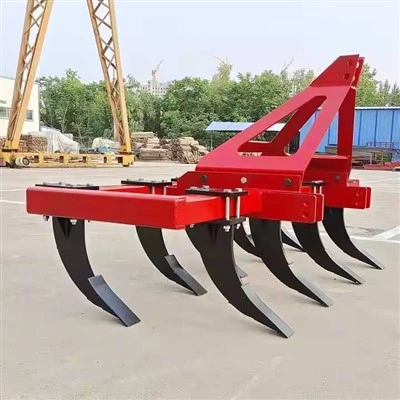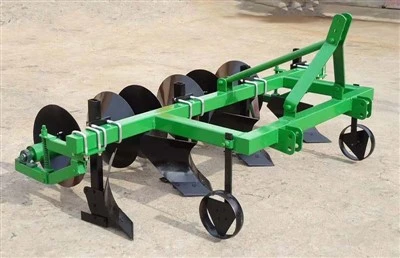


Tractor with drum 3S-1.0 agricultural tiller, deep loosening machine, soil cracking machine
Deep loosening plow professionally produced chisel plow is designed for deep cultivation of fields, capable of breaking hardened soil and retaining groundwater. It has adjustable working depth (15-30 centimeters), three-point suspension connection device, and customizable color options.
Suitable for farms and manufacturing plants, ensuring efficient productivity and providing one-year warranty support with sturdy design.

3S Deep loosening plow is mainly suitable for field deep plowing operations in potato, bean, pea, and cotton fields. This machine can crush hardened soil and free soil, and has the advantages of adjustable depth, wide applicability, and convenient hanging.
Key Components: It is mainly composed of a frame, tie bars, deep loosening chisels (the core working part), shear bolts, and depth-limiting wheels. The working parts are usually chisel-shaped tines mounted on the rear beam of the frame. The shear bolts protect the chisels from damage when encountering obstacles like tree roots or rocks. The depth-limiting wheels on both sides of the frame adjust and control the tillage depth.

3S Deep loosening plow is applicable to various soil types such as sandy loam, loam, and clay loam. It is often used for pre-sowing soil preparation of food crops such as corn and soybeans, as well as cash crops such as rapeseed. It is also widely used in soil remediation after heavy machinery operations in potato and sugar beet planting areas. However, it is not suitable for plots where there is a sand layer below 20cm of the plow layer, as it may lead to water and nutrient leakage.
Water Storage Capacity: Deep loosening plows create vertical "water channels" in the soil, improving infiltration of rainfall or irrigation water by 20–40%. This increases soil moisture retention by 10–25% in arid areas (e.g., northern China, parts of Indonesia's East Java), reducing drought stress for crops. Traditional plows, by contrast, form a loose but shallow surface layer that accelerates water evaporation.

Erosion Control: Retained surface residues act as a protective mulch, reducing wind erosion by 50–70% and water erosion (runoff) by 30–50%. Traditional plows expose bare soil after inversion, making it highly susceptible to erosion-especially on slopes or in areas with heavy rainfall (e.g., Indonesia's rainy season).
Root Development: By breaking the plow pan, deep loosening plows allow crop roots to penetrate 30–50% deeper, accessing more water and nutrients in the subsoil. This enhances crop resistance to lodging (e.g., in rice, corn) and drought. Traditional plows restrict roots to the shallow tilled layer, making crops more vulnerable to environmental stress.
Yield Increase: Long-term trials show that deep loosening plows increase grain crop yields by 5–15% (e.g., wheat, rice) and cash crop yields by 8–20% (e.g., sugarcane, palm oil, cotton). Traditional plows may deliver short-term yield gains due to residue burial but suffer from declining yields after 2–3 years due to soil degradation.
Hot Tags: deep loosening plow, China deep loosening plow manufacturers, factory
|
Tractor Hitch 3S Deep Subsoiler Model |
unit |
Deep loosening plow 3S-1.0 |
Deep loosening plow 3S-1.4 |
Deep loosening plow 3S-1.8 |
Deep loosening plow 3S-2.1 |
Deep loosening plow 3S-2.6 |
|
Working width |
mm |
1000 |
1400 |
1800 |
2100 |
2600 |
|
Working depth |
mm |
100-250 |
||||
|
No. of tines |
|
5 |
7 |
9 |
11 |
13 |
|
Total weight |
kg |
240 |
280 |
320 |
370 |
450 |
|
Matched power |
hp |
25 |
40 |
50~60 |
70~80 |
90~100 |
|
Linkage |
|
Three-point suspension I type |
Three-point suspension II type |
|||