



LEADRAY Compact 80HP Tractor Marketing Plan for Mexican Farmlands
I. Core Objectives of the Plan
Based on the operational scenarios of Mexican farmlands, accurately match the core needs of local farmers, agricultural cooperatives, and small-to-medium-sized farms. With "high adaptability, high durability, high cost-effectiveness + localized services" as the core, quickly improve the brand awareness and market share of LEADRAY Compact 80HP Tractor in the Mexican market. Prioritize breaking through the three core regions: northern large-scale farms, central plateau croplands, and southern small-scale farming areas. Establish stable sales channels and customer reputation, achieve sales of over 800 units within 12 months, become a mainstream alternative brand in Mexico's compact 80HP tractor market, and build a complete localized after-sales service system to improve customer repurchase rate and recommendation rate.

II. In-Depth Analysis of the Mexican Farmland Market
(I) Market Environment and Demand Pain Points
Mexico is a major agricultural country in Latin America, with 23.33 million hectares of arable land. Agriculture is the pillar industry of the national economy. Among them, corn, as the core food crop, has a planting area of nearly 8 million hectares all year round, accounting for 40% of the country's total arable land. In addition, sorghum, wheat, fruits and vegetables, and animal husbandry are also major agricultural sectors. Currently, Mexico's agricultural mechanization rate is continuously improving, reaching 68% in 2023. Among them, the demand for medium and large tractors with 80-120 horsepower is growing significantly. At the same time, more than 37% of in-service agricultural machinery has been used for more than 15 years, with an urgent need for renewal and replacement.
Combined with the actual scenarios of Mexican farmlands, the core demand pain points are as follows:
Terrain Adaptation Demand: 70% of Mexico's territory has a dry climate, with extensive plateaus and deserts, and few plains. The large-scale farmlands in the north are flat but need to cope with drought; the central plateau croplands have moderate slopes; the southern small-scale farming areas have scattered plots and narrow roads. Existing large tractors lack flexibility, while small tractors lack sufficient power. The compact size and strong power of the Compact 80HP can perfectly adapt to multi-terrain operations.
Operational Efficiency Demand: The transfer of rural labor to cities has led to rising labor costs. Farmers are eager to replace manual labor with efficient agricultural machinery, covering multiple links such as sowing, intertillage, harvesting, and traction. The 80HP horsepower can meet the full-process operations of major crops such as corn and sorghum, and is compatible with various agricultural tools such as rotary tillers and ditchers to improve operational efficiency.
Cost Control Demand: Mexican farmers generally face problems such as limited financing and high debt, and are highly sensitive to the price of agricultural machinery. At the same time, they attach importance to long-term use costs and are resistant to frequent maintenance and high spare parts costs. They need products with "high cost-effectiveness + strong durability + convenient maintenance" and reject equipment that is "high-priced but low-performance" or "low-priced but easy to damage".
Service Guarantee Demand: Mexico's agricultural machinery service outlets are unevenly distributed, with weak coverage in the southern and remote agricultural areas. Farmers are worried that agricultural machinery failures cannot be repaired in a timely manner, affecting the farming season (especially the critical sowing and harvesting periods of corn and wheat). There is a strong demand for localized after-sales services, fast spare parts supply, and operation training.

(II) Market Competition Pattern
Mexico's agricultural machinery market presents a moderately concentrated pattern. The top five brands (John Deere, CNH Industrial, AGCO Corporation, Kubota, Mahindra) occupy a dominant share. Among them, John Deere maintains a leading position with captive financing services; CNH Industrial adapts to Mexican needs through local assembly and customization; Kubota focuses on intelligence and service network construction. In addition, local brands such as Paciano Ríos and Agroservicios del Norte specialize in small and medium-sized machinery customization, with low prices but insufficient technology and durability.
The core focus of competition has shifted from simple price competition to comprehensive competition of "technology + service + finance". Although leading brands have channel and brand advantages, their prices are high and the supply cycle of spare parts is long; local brands have price advantages, but their power and durability cannot meet the needs of large-scale operations, and they lack intelligent configuration. LEADRAY Compact 80HP can fill the market gap with its differentiated advantages of "compact adaptation + strong power + high cost-effectiveness + fast localized services", catering to the needs of both large-scale farms and small and medium-sized farmers.
(III) Policy and Channel Opportunities
At the policy level, the Mexican government has launched the "Agricultural Modernization Incentive Program", providing farmers with subsidies of up to 40% of the equipment purchase price. At the same time, Mexico's National Bank for Financial Development (NAFIN) has launched the "Agricultural Machinery Lease Pass" program in cooperation with dealers, supporting lease services with a term of 3-5 years, which greatly reduces the threshold for farmers to purchase equipment. We can rely on policy dividends to reduce customer procurement costs and stimulate sales.
At the channel level, Mexican agricultural machinery dealers are mainly concentrated in cities such as Culiacán and Hermosillo, forming a mature distribution network. At the same time, digital procurement platforms (such as AgroMaquinaria.com.mx) are emerging, and the proportion of online transactions is increasing year by year, expected to reach 22% in 2027. In addition, agricultural cooperatives and regional agricultural machinery service stations are the core links connecting brands and farmers, and we can quickly penetrate the market through cooperation to achieve channel sinking to southern remote producing areas.
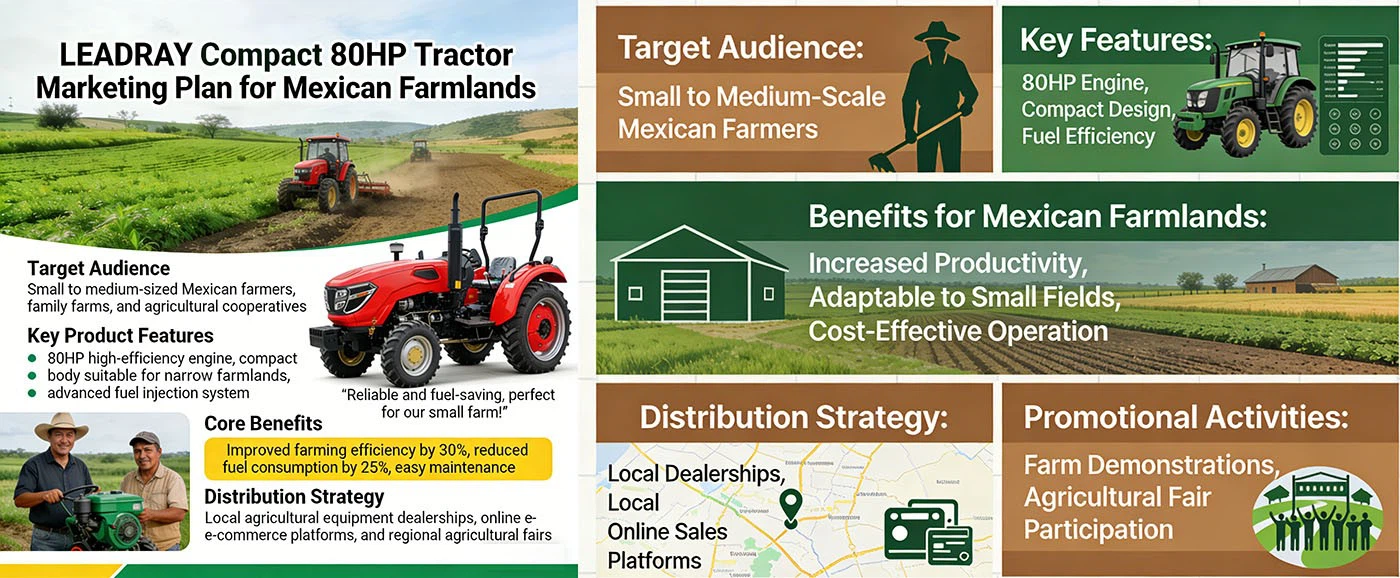
III. Product Positioning and Differentiated Advantage Extraction
(I) Core Positioning
Targeting the multi-terrain farmland operation scenarios in Mexico, it is positioned as an "all-round compact and efficient agricultural machinery" - adapting to northern large-scale farms, central plateau croplands, and southern scattered plots, balancing power and flexibility, covering multi-crop and multi-link operations. With "high cost-effectiveness, high durability, and localized services" as the core, it meets farmers' core demands of "low cost, high efficiency, and less trouble", and becomes the cost-effective first choice for Mexican farmers to purchase 80HP tractors.
(II) Differentiated Advantages (Adapting to Mexican Farmland Needs)
Terrain Adaptation Advantage: Compact body design with a small turning radius, which can flexibly shuttle through scattered small plots and narrow field roads in the south. At the same time, the chassis height is optimized to adapt to central plateau sloping croplands and northern arid plots, avoiding getting stuck and scratching. Compared with large tractors, the flexibility is improved by 30%; compared with small tractors, the power is increased by 50%, adapting to more than 70% of the farmland types in Mexico.
Power and Efficiency Advantage: 80HP powerful engine with low fuel consumption and large torque, compatible with various agricultural tools such as rotary tillage, sowing, harvesting, traction, and ditching, meeting the full-process operations of major crops such as corn, sorghum, and wheat. The daily operation area can reach 30-40 hectares. Compared with competitors of the same level, the operation efficiency is increased by 15% and the fuel consumption is reduced by 10%, helping farmers shorten the farming season and reduce fuel costs.
Durability and Low-Cost Advantage: Adopting thickened T4-grade steel sheet metal parts, wear-resistant and impact-resistant, adapting to Mexico's dry and dusty climate; dry air filter design can effectively filter dust and soil; enlarged water tank and hydraulic oil radiator avoid equipment damage due to high temperature; dual diesel tanks with large capacity have strong endurance and reduce refueling frequency; high universality of spare parts, convenient maintenance, and long-term use cost is 20%-30% lower than that of leading brands, and durability is 40% higher than that of local brands.
Localization Adaptation Advantage: Optimized engine heat dissipation system to adapt to Mexico's high-temperature and dry climate; adjusted operation interface to support Spanish, simple operation, no professional skill training required, fitting Mexican farmers' operation habits; reserved intelligent upgrade interface, which can be retrofitted with GPS navigation and fault detection system later, conforming to the trend of agricultural machinery intelligence in Mexico, while avoiding excessive initial cost investment.
Service and Financial Advantage: Commit to localized spare parts supply, establish spare parts warehouses in core producing areas, with a response time of no more than 48 hours; adopt mobile service vehicle mode in remote areas to achieve on-site maintenance; cooperate with local financial institutions to launch low-interest loans and financial leasing services, combined with government subsidies, to achieve "zero down payment and low monthly payment" to ease farmers' financial pressure; provide 1-year whole machine warranty and lifelong maintenance guidance, which is better than the after-sales service policies of some competitors.
IV. Precise Positioning of Target Customers
Combined with Mexico's agricultural structure and farmland characteristics, focus on three core customer groups to achieve precise reach:
Core Customer Group 1: Northern Large-Scale Farms (Sonora, Sinaloa) - Mainly engaged in commercial planting, planting corn, wheat, and vegetables, with flat and large plots. The key needs are efficiency, durability, and compatibility with various agricultural tools. They pay attention to the power and stability of agricultural machinery and have certain demand for financial services. They are the core contributors to sales. We can focus on promoting bulk purchase discounts and customized services.
Core Customer Group 2: Central Plateau Farmers (Mexico State, Puebla) - Planting corn and sorghum, with moderately sloping and medium-sized plots. The key needs are terrain adaptability and fuel economy. They are highly sensitive to price and pay attention to the convenience of after-sales services. They are the core group for brand word-of-mouth communication. We can focus on promoting cost-effectiveness and localized service advantages.
Core Customer Group 3: Farmers and Agricultural Cooperatives in Southern Small-Scale Farming Areas (Chiapas, Tabasco) - Scattered and small plots, narrow roads. The key needs are flexibility, easy operation, and low cost. Purchasing power is weak, relying on government subsidies and leasing services. They are the key targets for channel sinking. We can focus on promoting low-interest loans, leasing plans, and easy operation advantages.

V. Marketing Strategies and Implementation Plan (Phased Promotion)
The overall plan is divided into three phases: "Startup Phase, Promotion Phase, and Consolidation Phase". Combining online and offline channels, focusing on "experiential marketing + localized services + policy leverage", to ensure rapid market penetration, establish brand reputation, with a total cycle of 12 months.
(I) Startup Phase (Months 1-3): Market Breakthrough and Foundation Establishment
Core Objective: Complete localized layout, achieve initial brand exposure, reach the first 100 units of sales, and build the core channel framework.
Localization Cooperation Layout
Channel Cooperation: Sign exclusive agency agreements with 3-5 core agricultural machinery dealers in Mexico (focusing on covering core agricultural cities such as Culiacán, Hermosillo, and Guanajuato), requiring dealers to have a complete sales network and preliminary maintenance service capabilities; at the same time, cooperate with more than 20 regional agricultural cooperatives as grassroots outlets for product display and promotion to quickly achieve channel sinking.
Service Layout: Establish 3 regional after-sales service centers in Sonora, Mexico State, and Chiapas, equipped with professional maintenance technicians and common spare parts, reserve core spare parts of Compact 80HP tractor, ensuring that the maintenance response time does not exceed 48 hours; deploy mobile service vehicles to cover remote producing areas, providing on-site maintenance, maintenance, and operation training services; cooperate with local spare parts suppliers to reduce the cost of spare parts procurement and transportation and shorten the supply cycle.
Financial Cooperation: Cooperate with Mexico's National Bank for Financial Development (NAFIN) and 2 local commercial banks to launch financial plans suitable for farmers. Combined with the 40% government purchase subsidy, achieve "zero down payment, low-interest loans (annual interest rate not exceeding 5%), and 36 installments". At the same time, launch 3-5 year financial leasing services, with the option to repurchase or renew the lease upon expiration, reducing the threshold for farmers to purchase equipment and stimulating the first batch of purchases.
Small-Scale Experiential Promotion
Field Demonstrations: Hold 1 field demonstration in each of Sonora (northern), Mexico State (central), and Chiapas (southern), inviting local core farmers and agricultural cooperative leaders to participate. On-site demonstrate the operation effect of Compact 80HP tractor in sowing, rotary tillage, traction and other links, compare the flexibility, fuel consumption and efficiency with competitors, allowing farmers to intuitively feel the product advantages; provide test drive services after the demonstration, answer questions on the spot, and launch the preferential policy of "5% discount for on-site reservation" to promote the first batch of orders.
Precise Reach: Arrange sales personnel to go deep into towns in core producing areas, distribute Spanish brochures (focusing on terrain adaptation, high cost-effectiveness, and localized services), visit farmers and farms, understand actual needs, and introduce product advantages and financial subsidy policies in a targeted manner; collect potential customer information, establish customer files, and follow up and maintain them later.
Initial Brand Exposure: Use local agricultural media (newspapers, radio stations) and agricultural exhibitions (Mexico International Agricultural Exhibition) to launch product advertisements, focusing on promoting the adaptability and high cost-effectiveness of Compact 80HP tractor; open official Spanish social media accounts (Facebook, Instagram), release product videos and field operation cases to attract farmers' attention and accumulate initial fans.
(II) Promotion Phase (Months 4-9): Comprehensive Penetration and Sales Improvement
Core Objective: Expand brand awareness, cover the three core regions, reach 500 units of sales, establish stable customer reputation, and increase market share to about 8%.
Online and Offline Integrated Promotion
Online Promotion: Optimize social media content, regularly release product operation tutorials, maintenance skills, on-site field operation videos, and customer praise cases; conduct 1 live Q&A every week, inviting local agricultural machinery experts and old customers to share their use experience; launch products on local agricultural machinery digital procurement platforms such as AgroMaquinaria, provide online consultation and reservation services, and launch the preferential policy of "priority delivery + 1 free maintenance for online reservation"; launch targeted advertisements, pushing to farmers in core Mexican agricultural regions to improve the accuracy of exposure.
Offline Promotion: Hold 2-3 small-scale field demonstrations in different producing areas every month, covering more towns; participate in national agricultural exhibitions and regional agricultural machinery exhibitions in Mexico, set up brand booths, display Compact 80HP tractor and compatible agricultural tools, and carry out promotional activities on site (such as "buy tractor and get agricultural tools for free", "80% discount for bulk purchase"); encourage dealers and agricultural cooperatives to carry out "trade-in" activities, where old agricultural machinery can be used to offset part of the purchase price, stimulating the demand for equipment renewal and conforming to the trend of eliminating old agricultural machinery in Mexico.
Word-of-Mouth Marketing and Customer Maintenance
Old Customer Incentive: Launch the "Old Customer Referral Reward" activity. If an old customer refers a new customer to successfully purchase a tractor, they can get 1 free maintenance or a spare parts discount coupon; regularly visit old customers, understand the product use situation, provide free maintenance guidance, collect customer feedback, and timely optimize products and services; select high-quality customer cases, make them into promotional materials (videos, pictures and texts), and spread them through online and offline channels to enhance brand credibility.
Customer Training: Hold 1 farmer training every month in each regional after-sales service center, explaining tractor operation skills, daily maintenance methods, and fault diagnosis knowledge, improving farmers' operation ability, reducing equipment failures, and improving customer satisfaction; provide bulk training services for agricultural cooperatives to ensure that all members of the cooperative can proficiently operate the equipment.
Strengthening Differentiated Competition: Aiming at the pain point of high prices of leading brands, increase the promotion of high cost-effectiveness, highlight the price difference (20%-30% lower) between LEADRAY Compact 80HP tractor and products of the same level from John Deere and Kubota, and emphasize the advantages of durability and localized services; aiming at local brands, highlight the advantages of power, durability and intelligent adaptation, avoid low-price competition, focus on "cost-effectiveness + quality", and create a differentiated label; combined with the trend of agricultural machinery intelligence in Mexico, launch optional GPS navigation and fault detection systems to meet the precise operation needs of large-scale farms and improve product added value.
Policy Leverage: Closely connect with Mexico's Secretariat of Agriculture and Rural Development (SADER) to ensure that customers can smoothly enjoy government agricultural machinery purchase subsidies; arrange special personnel to assist customers in handling subsidy application procedures, simplify the process, and reduce customer concerns; take advantage of the policy dividends of the "Agricultural Modernization Incentive Program" to carry out joint promotional activities, further reduce customer procurement costs, and stimulate sales growth.
(III) Consolidation Phase (Months 10-12): Service Optimization and Market Stabilization
Core Objective: Consolidate market share, improve customer repurchase rate and recommendation rate, achieve a total sales of 800 units, establish LEADRAY's brand influence in Mexico's compact 80HP tractor market, and lay the foundation for long-term development.
Service Optimization and Upgrade: Expand the after-sales service network, add 1-2 after-sales service points in southern remote producing areas, increase the number of mobile service vehicles, and shorten the maintenance response time to within 24 hours; improve the spare parts supply system, increase the reserve of spare parts in core regional spare parts warehouses to ensure sufficient common spare parts, and optimize the spare parts distribution process to improve distribution efficiency; launch the "lifelong maintenance guidance" service to provide customers with long-term technical support and improve customer stickiness; introduce a Customer Lifecycle Management (CLM) system, conduct precise profiling based on agricultural machinery use data and maintenance records, and push personalized parts recommendations and agricultural advice to further improve customer satisfaction.
Deepening Customer Relationships: Hold customer appreciation meetings, inviting core customers, dealers, and agricultural cooperative leaders to participate, collect customer feedback, understand changes in market demand, and optimize products and services; establish a customer club, providing members with exclusive discounts, priority services, technical exchanges and other rights and interests to enhance customer sense of belonging; provide customized services for large-scale farm customers (such as customized compatible agricultural tools, exclusive maintenance plans) to improve the repurchase rate of large customers and promote bulk purchases.
Market Optimization and Expansion: Analyze sales data and customer needs in each region, focus on core regions with good sales, and increase promotion efforts; optimize promotion strategies for regions with poor sales, adjust the focus of product promotion to adapt to local farmland characteristics and farmers' needs; explore and expand surrounding small farms and animal husbandry customers, promote the auxiliary operation functions of tractors in animal husbandry such as traction and feeding, and expand the customer group; try to export to Central America and the Caribbean region, relying on Mexico's geographical advantages to expand the extended overseas market.
Brand Upgrade: Summarize the successful cases of the promotion phase, optimize brand promotion content, highlighting the brand image of "localization, high adaptability, and high cost-effectiveness"; increase brand advertising investment, covering more agricultural media and social media to improve brand awareness; participate in activities related to industry standard formulation, improve brand influence in the industry, and build a well-known brand in Mexico's compact agricultural machinery field.
VI. Pricing Strategy
Combined with Mexican farmers' purchasing power, market competition pattern, and product costs, formulate a differentiated pricing strategy, balancing cost-effectiveness and profit space, and relying on policy subsidies to reduce customers' actual costs:
Basic Pricing: The basic model of Compact 80HP tractor is priced at $18,000-$20,000 per unit, 20%-30% lower than products of the same level from John Deere and Kubota, and 10%-15% higher than high-quality local brands. It highlights the advantage of "cost-effectiveness + quality", which not only meets farmers' cost control needs, but also ensures product profits and service investment.
Differentiated Pricing: Launch basic models (meeting core operation needs), upgraded models (equipped with GPS navigation and fault detection system), and customized models (adapted to specific crops or terrains), with a price range of $18,000-$25,000 per unit, meeting the needs of different customer groups (large-scale farms choose upgraded/customized models, small and medium-sized farmers choose basic models); provide 80%-90% discount for bulk purchase customers (5 units and above) to stimulate large-scale purchases and increase sales.
Promotional Pricing: Launch "5% discount for on-site reservation" in the startup phase, "buy tractor and get agricultural tools for free" and "trade-in deduction of $1,000-$2,000" in the promotion phase, and "85% discount for old customer repurchase" and "free maintenance for both parties when referring new customers" in the consolidation phase; combined with the 40% government purchase subsidy, assist customers in reducing actual expenditure, allowing customers to feel the dual advantages of "high cost-effectiveness + policy dividends" and stimulate purchasing willingness.
Price Control: Sign a price control agreement with dealers to prohibit dumping at low prices or price gouging, ensuring uniform national prices and maintaining brand image; adjust prices in a timely manner according to changes in market demand and costs, but the adjustment range does not exceed 10% to avoid excessive price fluctuations affecting customer trust.
VII. After-Sales Service Strategy (Core Competitiveness)
Mexican farmers have strong demand for after-sales services. We will take after-sales services as the core competitiveness, build a "localized, fast-response, and comprehensive" service system, solve farmers' worries, and improve customer satisfaction and repurchase rate:
Warranty Service: Provide 1-year whole machine warranty, and 2-year warranty for core components (engine, gearbox). During the warranty period, free maintenance and replacement of spare parts are provided to eliminate farmers' maintenance costs; after the warranty period, provide preferential spare parts replacement services, with spare parts prices 15%-20% lower than competitors. At the same time, launch the "lifelong maintenance guidance" service to provide customers with long-term technical support and reduce customers' long-term use costs.
Fast Response Service: Establish a 24-hour service hotline (Spanish) to answer customer inquiries and fault reports in a timely manner; the maintenance response time in core producing areas does not exceed 48 hours, and in remote areas does not exceed 72 hours. On-site maintenance is realized by means of mobile service vehicles to avoid affecting the farming season due to equipment failures; during the busy farming season (sowing and harvesting periods), increase the number of maintenance technicians and mobile service vehicles to ensure fast response and improve customer experience.
Spare Parts Supply Service: Establish 3 core spare parts warehouses in Sonora, Mexico State, and Chiapas, storing common and core components of Compact 80HP tractor to ensure sufficient spare parts; cooperate with local spare parts suppliers to optimize the spare parts procurement and distribution process, shorten the spare parts supply cycle, and avoid long-term equipment idleness due to lack of spare parts; launch the "spare parts door-to-door delivery" service to provide convenient spare parts supply support for customers in remote producing areas, further improving service convenience and customer satisfaction.
Training Service: Regularly hold farmer training, explaining tractor operation skills, daily maintenance methods, and fault diagnosis knowledge, improving farmers' operation ability, reducing equipment failures; provide customized training services for agricultural cooperatives and large-scale farms to ensure that relevant personnel can proficiently operate the equipment; provide online training videos (Spanish) to facilitate farmers to learn at any time, improve the coverage and convenience of training, reduce training costs, and enhance customer stickiness and satisfaction.
Customer Feedback Service: Establish a customer feedback mechanism to collect customer feedback on products and services through telephone, visits, social media and other channels; arrange special personnel to handle customer complaints and suggestions, solve customer problems in a timely manner, and rectify deficiencies; summarize customer feedback every quarter, optimize product design and service processes, continuously improve product adaptability and service quality, enhance customer stickiness and brand loyalty, and promote customer repurchase and recommendation.
VIII. Risk Prevention and Control
Combined with the characteristics of the Mexican market, predict potential risks in advance and formulate response measures to ensure the smooth progress of the marketing plan and reduce losses:
Market Competition Risk: Leading brands may squeeze market space by reducing prices and increasing promotion efforts, and local brands may engage in vicious low-price competition. Response Measures: Continuously strengthen differentiated advantages, focus on "terrain adaptation + localized services + high cost-effectiveness", and do not blindly participate in low-price competition; accelerate the layout of localized services to improve customer stickiness; optimize product functions and launch upgraded products adapted to the Mexican market to improve product added value and consolidate market share; strengthen brand building to improve brand influence and reduce the impact of competition.
Policy Risk: Changes in Mexican government agricultural subsidy policies or import and export policies may affect customer purchasing power and product circulation. Response Measures: Establish close cooperative relations with local government departments, pay close attention to policy changes, and adjust marketing strategies in a timely manner; diversify policy support channels, not only rely on government subsidies, but also strengthen cooperation with financial institutions to reduce the impact of policy changes; optimize the import and export process, understand relevant policy requirements in advance, and avoid risks such as customs clearance delays.
Service Risk: Insufficient after-sales service capabilities, delayed spare parts supply, or unprofessional maintenance technicians may affect customer satisfaction and brand reputation. Response Measures: Strengthen the training of maintenance technicians, improve their professional skills, and conduct regular assessments; increase the reserve of spare parts and optimize the supply chain to ensure timely supply of spare parts; establish a service supervision mechanism to supervise the service quality of dealers and after-sales service centers, and rectify unqualified services in a timely manner.
Financial Risk: Default on loan repayment by farmers or financial risks of cooperative financial institutions may affect cash flow. Response Measures: Strictly review the credit status of farmers when providing loan services to reduce the default risk; cooperate with formal and powerful financial institutions to ensure the stability of financial services; formulate a reasonable loan repayment plan, flexibly adjust the repayment cycle according to the farming season and farmers' income, and reduce the repayment pressure of farmers.
Cultural and Language Risk: Differences in Mexican local culture, customs, and language may affect the effectiveness of promotion and customer communication. Response Measures: Recruit local sales and service personnel who are familiar with local culture and language to improve communication efficiency; adapt promotional materials and service methods to local customs and habits, avoiding cultural taboos; provide Spanish training for overseas team members to enhance cross-cultural communication capabilities.
IX. Effect Evaluation and Adjustment
Establish a scientific effect evaluation system to track and analyze the implementation effect of the marketing plan in real time, and adjust the strategy in a timely manner according to the evaluation results to ensure the achievement of core objectives:
Sales Evaluation: Track monthly sales data, including total sales, sales in each region, sales by customer group, and sales of different product models; compare with the planned sales target, analyze the gap and reasons, and adjust the promotion strategy and channel layout for regions and customer groups with low sales.
Brand Evaluation: Track brand awareness and reputation through questionnaires, customer interviews, and social media comments; count the number of social media fans, interaction rate, and positive comment rate; evaluate the effect of brand promotion activities, and optimize the promotion content and channels if necessary.
Customer Evaluation: Conduct regular customer satisfaction surveys, including satisfaction with product quality, price, after-sales service, and promotion activities; track customer repurchase rate and recommendation rate; collect customer feedback and suggestions, and optimize products and services in a timely manner.
Channel Evaluation: Evaluate the sales capacity and service quality of dealers and agricultural cooperatives, including sales volume, customer coverage, after-sales response speed, and customer satisfaction; eliminate dealers with poor performance and strengthen cooperation with high-quality dealers; expand the number of cooperative channels according to market demand.
Budget Evaluation: Track the use of the marketing budget monthly, analyze the input-output ratio of each link; adjust the budget allocation for links with low efficiency, and increase investment in links with high returns to ensure the rational use of funds.
Adjustment Mechanism: Hold a monthly marketing work meeting to summarize the implementation effect of the plan, analyze existing problems, and put forward adjustment measures; conduct a comprehensive review every quarter, adjust the marketing strategy, implementation plan, and budget allocation according to market changes and customer needs, ensuring that the plan is always compatible with the Mexican farmland market and achieves the core objectives.
Hot Tags: compact 80hp tractor, China compact 80hp tractor manufacturers, factory, farm work tractor, Red 70hp Farm Tractor, tractor chipper attachment, tractor crop cultivation, tractor harrow hookup, tractor maintenance


