Agricultural tractors have several common power output modes, each designed to meet different operational requirements. Here are the main ones:
Agricultural tractors Power Take - Off (PTO)
Working principle: The PTO is a crucial device for transmitting the engine's power from the tractor to agricultural implements. Agricultural tractors is directly connected to the tractor's transmission system. Through components such as gears and chains, the rotational power of the engine is transferred to the PTO shaft, which then drives the attached implements.
Types and application scenarios
Standard - speed PTO: There are two common standard speeds: 540 revolutions per minute (RPM) and 1000 RPM. A 540 - RPM PTO is suitable for most medium - to low - speed implements, like rotary tillers and lawn mowers. These implements can meet the operational requirements at relatively low speeds, ensuring stable and high - quality work. The 1000 - RPM PTO is mainly used for high - speed implements such as large - scale combine harvesters and high - speed rotary tillers, providing higher power output to improve work efficiency.
Half - PTO: The speed of a half - PTO is not a fixed standard value; instead, it varies with the tractor's traveling speed. This power output mode is suitable for implements that need to match the tractor's speed, such as seeders and fertilizer spreaders. During operation, as the tractor's forward speed changes, the working speed of the implement can be adjusted accordingly to ensure uniform and accurate operation.

Agricultural tractors Hydraulic Power Output
Working principle: The Agricultural tractors hydraulic power output system uses a hydraulic pump to convert the engine's mechanical energy into hydraulic energy. High - pressure oil is then transported through hydraulic hoses to hydraulic actuators (such as hydraulic cylinders and hydraulic motors). These actuators convert the hydraulic energy back into mechanical energy to drive the implements.
Application scenarios
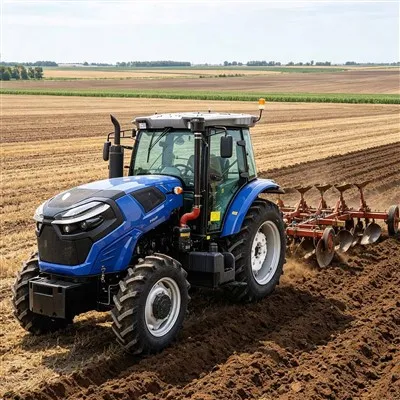
Lifting and suspending implements: The hydraulic system allows for convenient control of the implement's lifting and lowering, enabling quick installation and removal of implements and adjustment between different working depths and heights. For example, during plowing operations, the depth of the plow can be flexibly adjusted according to soil conditions and tillage requirements.
Driving hydraulic implements: Some special implements, such as hydraulically - driven rakes and hydraulic reversible plows, rely on the hydraulic power output system for power. Hydraulic - driven implements have the advantages of compact structure, smooth power transmission, and stepless speed adjustment, making them adaptable to different operational needs.
Agricultural tractors Mechanical Transmission
Working principle: Mechanical transmission uses mechanical components such as gears, chains, and belts to transfer the engine's power to various working parts of the tractor and attached implements. For example, different gear combinations in the gearbox enable different traveling speeds and torque outputs of the tractor. Chains or belts can transmit power to the wheels or other working components.
Application scenarios
Travel drive: Mechanical transmission is the main power transfer method for the tractor's traveling system, ensuring that the tractor can operate normally under different terrains and working conditions. By rationally designing the gear ratios of the gearbox, the tractor can have sufficient traction during field operations and a suitable traveling speed on roads.
Driving simple implements: For some simple - structured and low - power - demand implements, such as small threshers and hay cutters, they can be directly connected to the tractor through mechanical transmission and use the tractor's power for operation. This connection method is simple, reliable, and cost - effective.