

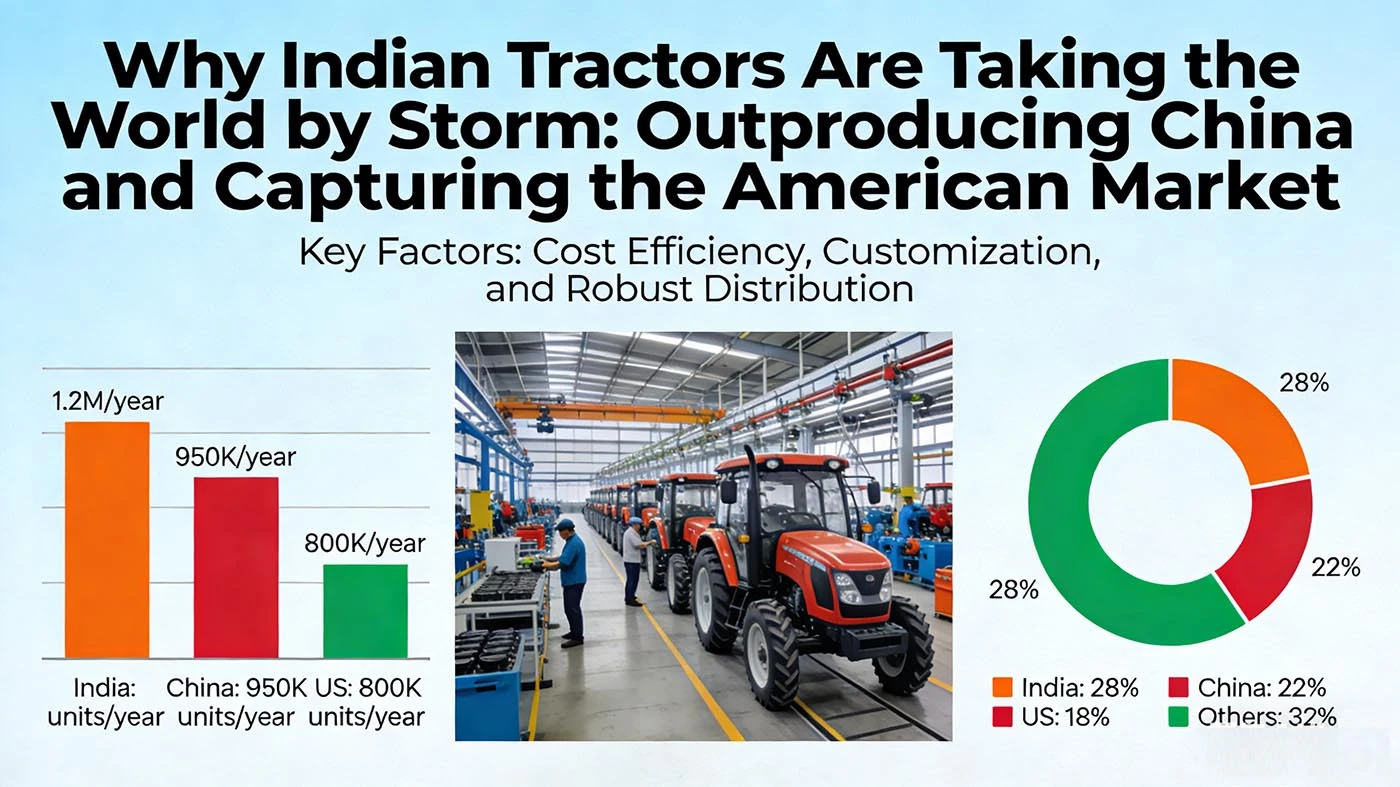
Indian tractor manufacturing has emerged as a global powerhouse, earning the title of world's largest producer and gaining significant traction in markets like the United States, Africa, and South Asia. Contrary to simple comparisons, this success stems not from being "better than China," but from strategic specialization and a bulk-tailored business model that dominates its niche.
First-Mover Advantage & Policy Backing
Early Start: India's tractor industry began in the 1940s and boomed during the Green Revolution in the 1960s. By 1973, imports had fallen to just 8.5%, establishing self-reliance.
Government Support: Long-term policies included low tax rates, subsidized credit, and joint ventures (with Germany, the USSR, etc.) to fast-track technology and local production.
Niche Market Precision
Focus on Smaller HP: India dominates the sub-80 horsepower segment, perfectly suited for small, fragmented farmland plots common in the developing world.
Total Value Proposition: Their tractors offer lower fuel consumption, ease of use, and superior durability in harsh conditions at a price point 30-50% lower than Western alternatives. Flexible financing, including installment plans and even "crop exchange" payment schemes, make them accessible to smallholder farmers.
Hyper-Localized Service Network
On-the-Ground Adaptation: Models are optimized for local challenges, such as better cooling for hot climates and reinforced chassis for muddy terrain.
Last-Mile Support: A dense network of dealerships and service centers covers rural areas, ensuring fast, affordable repairs and a ready supply of parts. This "support ecosystem" is often cited as the key to customer loyalty.
Economies of Scale
Mass Production: With annual output exceeding 900,000 units (accounting for over 40% of global supply), India achieves massive economies of scale, driving down manufacturing costs.
Supply Chain Integration: Leaders like Mahindra have fully integrated supply chains, leveraging cost-effective labor and component sourcing to maintain price competitiveness.
India vs. China: A Tale of Two Strategies
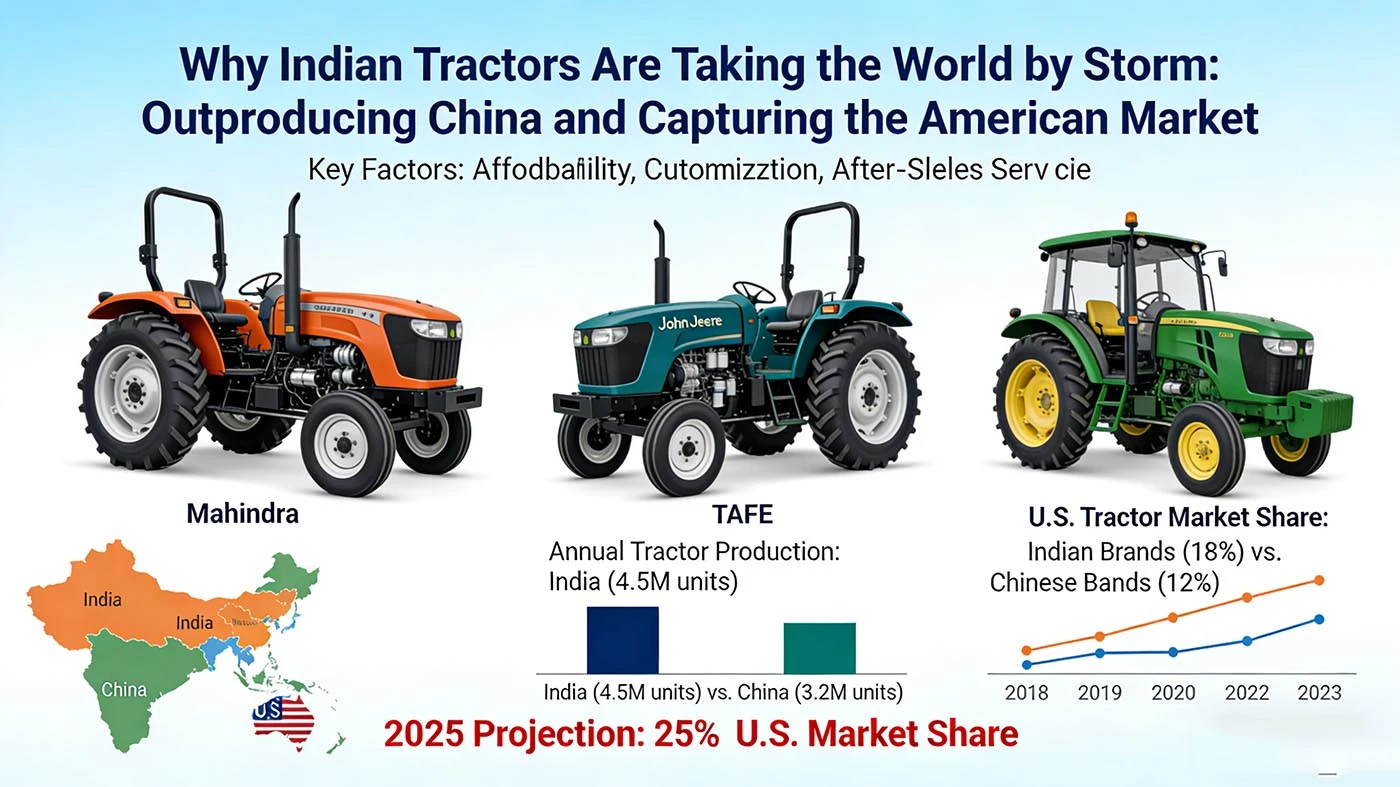
The competitiveness of Indian and Chinese tractors lies in their different market positioning and growth trajectories.
| Dimension | India's Tractors | China's Tractors |
|---|---|---|
| Output & Positioning | #1 Globally (900k+ units). Focus on sub-80 HP compact models. | #2 Globally. Strong growth in high-horsepower (100 HP+) and smart machinery. |
| Export Markets | Strongholds in the USA, Africa, and South Asia. | Growing presence in Southeast Asia, Eastern Europe, and Latin America. |
| Key Strengths | Low cost, environment adaptability, extensive service network, flexible financing. | Complete industrial chain, technological innovation, high-end intelligentization capability, fast iteration. |
| Core Challenges | Limitations in high-end technology and emissions standards. | Intense price competition in the compact segment; service network lagging in some regions. |
China's Path to Breaking Through: Differentiated Growth
China is not falling behind; it is simply competing in a different league. The country is successfully shifting from "price-based exports" to "value-based outputs" to carve out its global niche.
Upgrade to High HP & Intelligence
China is investing heavily in 100+ HP large-scale and smart, driverless agricultural machinery to target markets like the US and large-scale farms in Europe and Australia.
Environmental Adaptation
For emerging markets, China is developing customized compact models (25-50 HP) optimized for hot, dusty, and muddy conditions. Exports in this segment surged by 60% in 2025.
Build Local Service Infrastructure
To replicate India's success, China is expanding local assembly plants, parts distribution centers, and after-sales services abroad. The goal is to solve the core customer problem: "affordable, reliable, and easy to repair."
Leverage Industrial Completeness
China's unique position as the world's most complete industrial manufacturer allows for rapid product iteration and superior reliability, enabling it to outpace competitors in quality and speed to market.

Conclusion
India's dominance is a masterclass in strategic niche fulfillment, built on policy, scale, and an unrivaled service network for the sub-80 HP segment.
China, however, possesses the industrial depth and technological agility to reshape the global market by excelling in high-horsepower, smart agriculture and by offering highly adapted solutions for emerging markets. With exports reaching CNY 67.4 billion in 2025 (a 32.3% year-on-year increase), China's agricultural machinery sector is on a clear path to global leadership through innovation and value addition.


