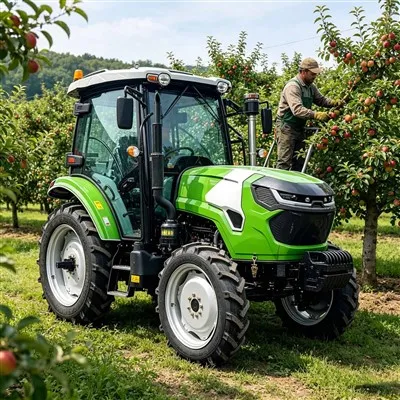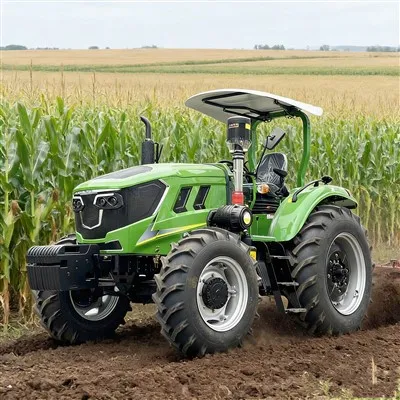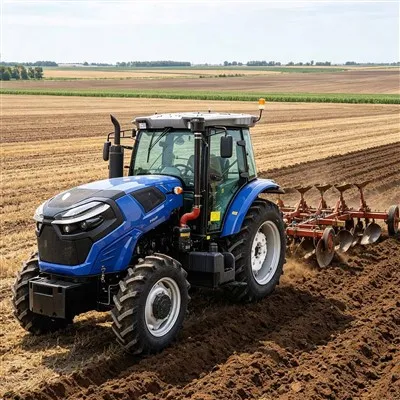
The matching between small four - wheel tractors and small agricultural machinery is a key factor affecting operational efficiency, equipment service life, and operational safety. It mainly covers multiple core aspects such as power, mechanical connection, operational parameters, and functional applicability.
The specific matching requirements are as follows:
Power Matching
Consistent Power Rating: The supporting power specified in the agricultural machinery manual must match the rated power of the small four - wheel tractor. If the tractor's power is excessively higher than that required by the agricultural machinery, it will lead to poor operational economy and may even damage the farm tools due to excessive power output. Conversely, if the agricultural machinery's power demand exceeds the tractor's output capacity, the tractor will be overloaded.
This not only results in low operating efficiency of farm tools such as plows and seeders but may also cause malfunctions in the tractor's engine and transmission system.
Meanwhile, a moderate power margin should be retained. Generally, it is reasonable for the tractor's remaining power to be 10 - 15% of the agricultural machinery's required power to cope with complex working conditions like hard soil.

Consistent Rotational Speed: The power output shaft speed of the small four - wheel tractor must align with the input speed required by small agricultural machinery.
For example, when matching with rotary tillers and straw crushers, inconsistent speeds will cause problems such as insufficient tillage depth or uneven crushing. In severe cases, it may damage the transmission components of both the tractor and the agricultural machinery.
Before operation, it is necessary to check and adjust the speed through the tractor's gearbox or the agricultural machinery's speed regulating mechanism to ensure consistency.
Mechanical Connection Matching
Matching Suspension Parameters: Most small agricultural machinery (such as small plows and seeders) is connected to tractors via a three - point suspension mechanism. The suspension rod length, attachment point position, and lifting stroke of the tractor must match the agricultural machinery. Specifically, the attachment point of the agricultural machinery should fall within the reasonable working range of the tractor's lower link and upper link.
As per the calculation of the tractor's suspension instantaneous center pi1 point design area, the agricultural machinery's column height and tilt angle after being lifted should meet the transportation and operation gap requirements. Moreover, the maximum lifting load of the tractor's suspension mechanism must be greater than the weight of the supporting agricultural machinery.
For instance, if the rated lifting load at the tractor's attachment point is 2940N, the weight of the matched agricultural machinery must not exceed the limit derived from the relevant lever principle formula to ensure smooth lifting and lowering during operation.

Reasonable Transmission Shaft Angle: When the tractor's power output shaft drives agricultural machinery through a universal joint drive shaft, the angle constraint must be observed. During normal farming operations, the angle between the power output shaft and the universal joint drive shaft should not exceed 10 degrees.
When lifting agricultural machinery for turning at the field edge, the angle between the power output shaft, the agricultural machinery's input shaft, and the drive shaft should not exceed 30 degrees.
At this time, the height of agricultural machinery components such as the rotary tiller's blade roller from the ground should be no less than 250mm to prevent the universal joint from being damaged due to excessive stress during operation.
Additionally, the safety clutch on the drive shaft must be effective and able to slip in case of overload to protect both the tractor and the agricultural machinery.
Operational Parameter Matching
Matching Operation Width: The operation width of small agricultural machinery should be compatible with the tractor's wheelbase and operational stability. For example, when a small four - wheel tractor is matched with a seeder or a harrow, the operation width of the farm tool should not be excessively wider than the tractor's wheel gauge.
Otherwise, it will easily cause the tractor to tilt during operation, affecting operational quality. It is optimal for the operation width to be an integer multiple of the tractor's effective traction range, which can reduce repeated operations or missed plowing areas and enhance operational efficiency.
Coordination of Operational Speed: The tractor's traveling speed should match the operational speed requirements of the agricultural machinery. For example, when matching with a precision seeder, an overly fast speed will lead to uneven seeding spacing and shallow seeding depth. When paired with a sprayer, an inappropriate speed will result in uneven pesticide application.
Therefore, it is necessary to select the appropriate tractor gear and traveling speed according to the agricultural machinery's operational characteristics to ensure the stability of operational quality.

Functional and Environmental Applicability Matching
Adaptation to Operational Scenarios: The combination of the tractor and agricultural machinery should be tailored to the local geographical environment and operational tasks. For hilly and mountainous areas with small plots and steep slopes, the small four - wheel tractor should be matched with narrow - width, lightweight agricultural machinery such as small - sized furrow openers and mini harvesters. This can avoid difficulties in turning and moving. In plain areas with large - scale operations, it can be paired with agricultural machinery with slightly larger operation widths, like wide - span harrows and multi - row seeders, to improve efficiency.
Compliance with Agronomic Requirements: The matched combination needs to meet local agronomic standards.
For example, in paddy - planting areas, when matching a small four - wheel tractor with a rice transplanter or a puddler, the machinery combination should ensure the appropriate depth of the puddled soil and the flatness of the field.
For dryland crop - planting areas, the combination of a tractor and a planter should guarantee the consistency of seeding depth and row spacing to meet the growth needs of crops.

Safety and Standardization Matching
Equipped with Safety Protection Devices: The matched agricultural machinery should be equipped with complete safety components that are compatible with the tractor.
For example, the safety shields of rotary tillers, the overload protection devices of conveyors, etc., should be properly installed and effective. Simultaneously, the safety warning signs of both the tractor and the agricultural machinery should be complete and clear to remind operators of operational risks.
Consistent Standardization Level: Priority should be given to agricultural machinery with high standardization and good versatility. Such agricultural machinery usually has uniform connection interfaces and component specifications that match most small four - wheel tractors of the same type.
Additionally, standardized accessories are easy to purchase, which can reduce maintenance difficulty and costs. For instance, choosing agricultural machinery that complies with national universal suspension standards allows for quick switching between different farm tools, improving the utilization rate of the tractor.