Trapped between standard agricultural tractors and remote-controlled tracked lawn mowers when purchasing agricultural equipment? Many landowners, orchard managers, and contractors are confused because these two machines solve very different real-world jobs.
Neither of them is omnipotent, it all depends on your wilderness terrain, daily work, and the tasks you actually need to complete each month.
40-150HP agricultural tractors are your multi-purpose main force for general agricultural production. It pulls plows, rotary tillers, seeders, fertilizing machines, and heavy-duty agricultural trailers through flat or gentle farmland.
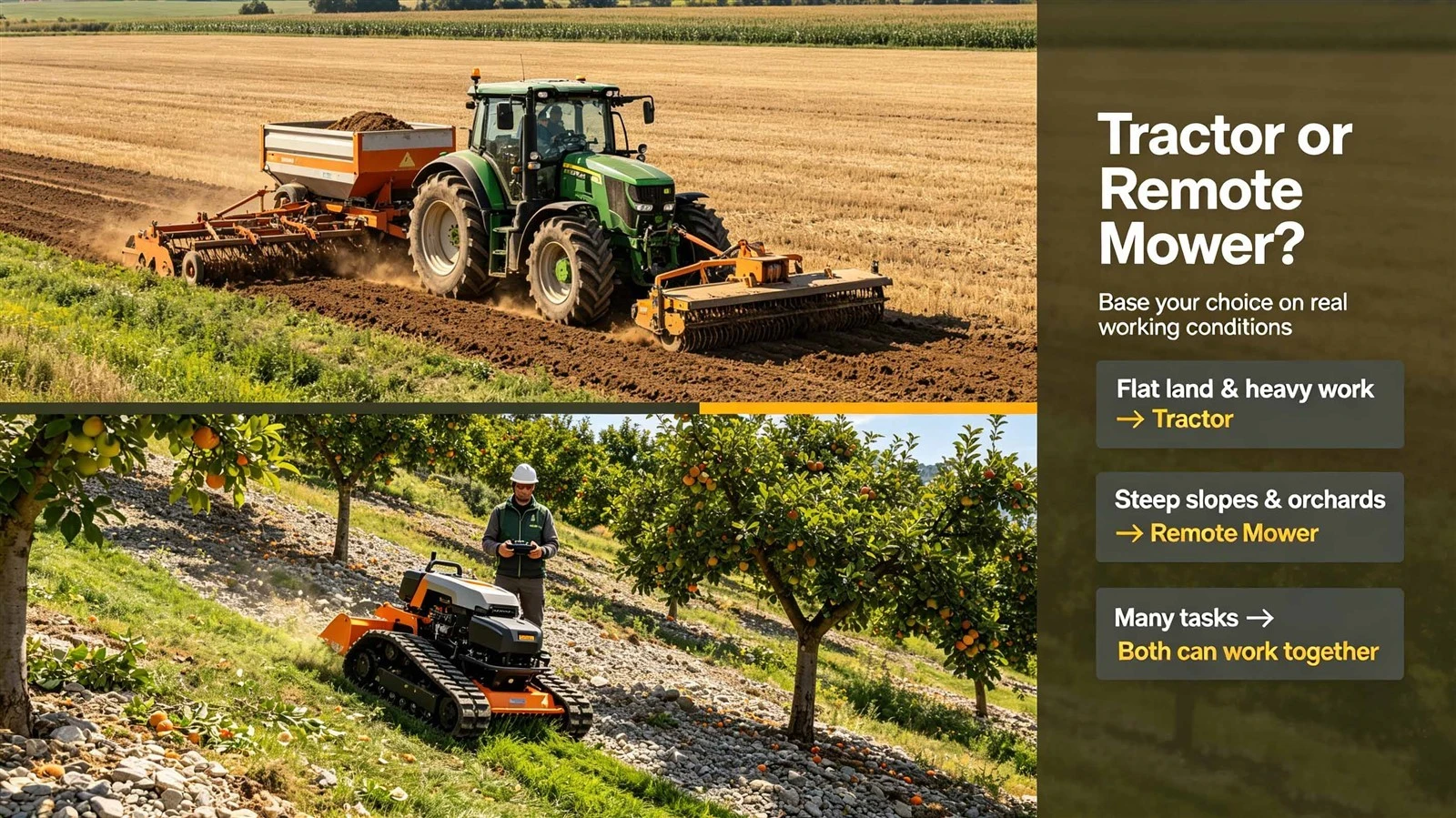
If your main job includes land preparation, planting, harvesting, transportation, and heavy-duty transportation, you cannot replace the tractor. It can quickly cover open farmland, handle continuous heavy loads, and support dozens of different farming tools for year-round farm cycling.
However, tractors show obvious limitations on tricky terrain. When you encounter steep slopes, steep slopes, narrow orchard rows, slippery muddy slopes, or rocky embankments, driving a tractor becomes risky.
On sloping wet soil, wheel slippage increases sharply. In many orchards, standard tractors simply cannot operate without damaging tree trunks or being trapped in low-lying, damp areas. This is where the R55, R80, R100, and R120 remote tracked lawn mowers intervene.
The remote tracked lawn mower is designed specifically for clearing vegetation, mowing, and clearing shrubs on hard to reach surfaces. Thanks to the rubber track chassis, they have good traction on steep slopes that are difficult for wheeled tractors to navigate.
The operator stands on a safe flat ground and remotely controls the machine without the need to ride or walk through dangerous hills.
The compact body is tightly installed between the rows of fruit trees, so it won't touch the bark when trimming weeds. R55 is suitable for maintenance of small orchards; R80 is used to balance daily medium-sized work; R100 and R120 are responsible for clearing dense overgrown shrubs and large hillside land.
But we need to maintain realistic expectations. Remote lawn mowers can mow grass and clean shrubs, but they cannot plow, pull heavy trailers, or operate planting tools. It will not replace your tractor for core farm farming work.

So, how do you make decisions in practical operation?
If the following situations occur, please use an agricultural tractor:
Most of your land is flat or slightly undulating large farmland.
Main tasks: plowing, cultivating, sowing, transporting heavy objects, and multi machine farm production.
You need a machine to complete the entire crop growth cycle.
If the following situations occur, please use a remote-controlled tracked lawn mower:
Most of your land is steep slopes, embankments, hilly wasteland.
Main tasks: weeding in orchards, clearing shrubs on mountain slopes, and managing roadside vegetation.
You want to avoid operator safety risks when working on slippery and uneven terrain.
A considerable number of commercial farms operate these two machines simultaneously.
Tractors are responsible for the main field cultivation work, while remote tracked lawn mowers are responsible for maintaining orchard rows, slopes, and dangerous areas that tractors cannot safely reach. Before placing an order, please draw your actual on-site working conditions, not just compare the specification numbers on the brochure. Your actual land condition will always be your best purchasing reference.