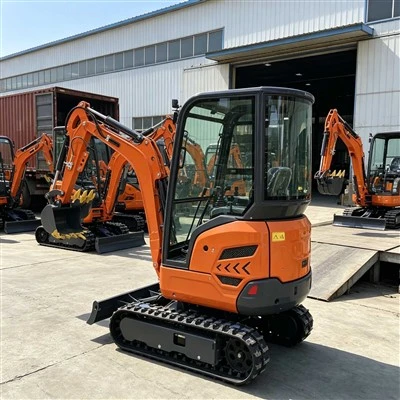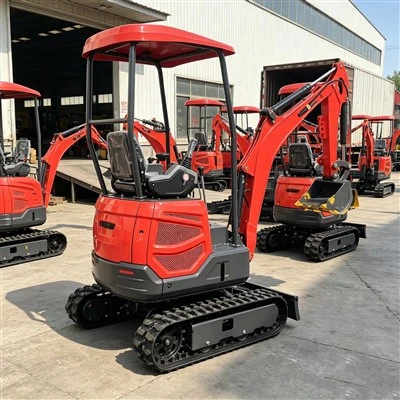
Excavator
Function and application: Mainly used for excavating materials above or below the bearing surface, such as soil, coal, silt, as well as pre-loosened soil and rocks, etc., and can load materials into transport vehicles or unload them to the storage yard. It can be used in earthwork operations, mining, tunnel excavation, infrastructure construction, demolition and other fields.
Working principle: The movement of each component is controlled by the hydraulic system, including the extension, rotation and up and down movement of the boom, boom and bucket. The cutting edge of the bucket is used to dig materials. The rotation mechanism can make the entire working device rotate within a certain range to expand the working range.
Category: Mini excavator, with a total weight of 6 tons or less including 6 tons, suitable for narrow sites; Medium-sized excavators, with a total weight of more than 6 tons but less than 40 tons including 40 tons, are commonly seen on general construction sites. Large excavators, with a total weight of over 40 tons, are mostly used in large-scale projects such as mining.
Backhoe excavator, with the bucket installed in reverse, retreats and cuts down to force soil cutting, is used for efficient excavation in mines and other places. Wheeled excavators have their lower body tracks modified into tires. They have a fast moving speed and strong mobility, but their adaptability to complex road surfaces is slightly poor. Dredging vessels, with their bodies attached to the hull, are used for water excavation operations, such as removing silt from rivers, lakes and reservoirs.
Loader
Function and application: Widely used in construction projects such as highways, railways, buildings, hydropower, ports, and mines, it is mainly used for loading bulk materials such as soil, sand, gravel, lime, and coal. It can also perform light excavation operations on ores and hard soil, and is capable of material handling, unloading, and site leveling.
Working principle: It relies on the engine to provide power, and through hydraulic transmission or mechanical transmission systems, it drives the wheels to move and the working device to operate. The working device mainly includes the bucket, boom, rocker arm, etc. The lifting and flipping of the bucket are controlled by the hydraulic system to achieve the loading and unloading operations of materials.
Classification: According to engine power, they are divided into small loaders (power less than 74kw), medium loaders (power between 74-147kw), large loaders (power between 147-515kw), and extra-large loaders (power greater than 515kw). According to the transmission form, it can be classified into hydraulic-mechanical transmission, hydraulic transmission and electric transmission. It is classified into tire type and track type according to the walking structure. According to the loading and unloading methods, they are classified into front-unloading type, rotary type and rear-unloading type.